Profile A
The recently laid-off executive
The search for the next role is running six months or longer. Going fractional turns that dead time into a practice that does not depend on a hiring manager's calendar.
The Pivot Lab Field Report · July 2026
The senior operator's guide to selling executive expertise by the slice: what going fractional actually means, what fractional executives charge in 2026, and the 60-day path from a corporate title to a first monthly retainer.
Before you read on
The fractional readiness score
Answer all five, then tell us where to send your score and what we would honestly tell you to do next.
1. How many years have you spent owning outcomes, not just contributing to them, in a function companies budget for?
2. Can you say, in one sentence, the expensive problem you solve and who inside a company owns fixing it?
3. How many people in your network have seen your work firsthand and could vouch for it today?
4. Could you fund roughly 60 days of building before a first retainer signs?
5. What kind of path are you actually looking for?
01
The definition
go·ing frac·tion·al
verb phrase · the 2026 career move nobody's manager explains
Selling your executive expertise to more than one company at a time, on recurring monthly retainers, instead of holding a single full-time role. A fractional executive typically serves two to four clients and gives each one a slice of the week: the same senior judgment a full-time hire would bring, at a fraction of the cost of a $150K to $300K salary line.
Inside a company, your expertise has a built-in path to problems, budgets, and decisions. The skill is yours. The channel is borrowed. The day you leave, by choice or otherwise, the channel goes back. Job seekers respond by asking another employer to lend them a new one, which is why senior searches now run six months or longer. Going fractional is the other response: you keep the expertise and replace the borrowed channel with one you own, serving several clients who pay monthly for the judgment your last employer got on salary.
The label matters less than the structure. Fractional CFO, fractional CMO, fractional CTO, fractional COO, fractional general counsel: in every case the buyer is a company that needs senior-level ownership of a function but cannot justify, or cannot find, the full-time hire. They are paying for outcomes, not headcount.
2 to 4 clients
Not one employer. Losing one client is a bad month, not a career event.
Monthly retainers
Recurring engagements, not hourly piecework or one-off projects.
Outcomes, not headcount
The buyer gets senior judgment without the salary, equity, and search cost.
02
The market math
These are typical published ranges, per client, per month. They hold because the alternative is worse for the buyer: a full-time CFO costs $150K to $300K in base salary alone, before bonus, equity, and the months it takes to run the search.
Independent strategy consultants working hourly bill $300 to $750 per hour in the same market. The retainer model usually wins on both sides: the client gets continuity, and you get revenue you can forecast.
2 × $12.5K
Two clients in the middle of the CFO band is a $25,000 month. That is the entire premise of going fractional: you do not need a funnel, an audience, or thirty clients. You need two or three companies that already believe you.
Work the numbers for your own seat with the consulting retainer pricing calculator, decide retainer or project first, and put the scope in writing with the consulting agreement and SOW example. Coming from finance? Read how to become a fractional CFO.
You did not lose your expertise. You lost a distribution channel.
03
The alternatives
People use these words interchangeably. Buyers do not. Knowing which structure you are selling, and which one the client thinks they are buying, is half of pricing well.
| Dimension | Going fractional | Project consulting | Interim executive | Full-time role |
|---|---|---|---|---|
| What it is | Ongoing ownership of a function for several clients at once | A defined engagement with a start, an end, and a deliverable | One company, full-time, for a bridge period (a departure, a raise, a turnaround) | One employer owns your entire working week |
| Time per client | A day or two per week, recurring | Varies by scope, then ends | Five days a week, temporarily | All of it |
| How you are paid | Monthly retainer, typically $8K to $35K depending on function | Project fee or $300 to $750 per hour | Monthly or day rate, single source | Salary, bonus, equity |
| Income shape | Recurring and stackable across clients | Lumpy; pipeline restarts after each project | Stable until the assignment ends | Stable until it is not |
| Leverage | You own the channel. Losing one client cuts income; it does not zero it | You own the craft; the channel resets every engagement | Borrowed channel, single point of failure | Borrowed channel, single point of failure |
04
The readiness check
Going fractional is not an entry-level move, and it is not a lifestyle brand. It works when the market already prices your judgment at a senior level. Four profiles show up again and again.
Profile A
The search for the next role is running six months or longer. Going fractional turns that dead time into a practice that does not depend on a hiring manager's calendar.
Profile B
Still employed, still paid, and quietly building the structure now: positioning, pipeline, contracts. The handcuffs come off on a schedule you choose.
Profile C
Finance, marketing, technology, operations, legal, HR. Fields where expensive problems need experienced operators and where a full-time hire is slower and costlier than a fraction of you.
Profile D
Already has clients or conversations, but pricing, pipeline, and delivery are still improvised. Going fractional properly means putting a system under what instinct started.
Curious exactly where you land? Take the 60-second readiness score at the top of this report.
Not ready to decide today?
A working PDF that maps the first weeks of the pivot, in your inbox in about a minute. A short series on landing the first client follows; unsubscribe with one click.
05
The 60-day path
The sequence below is the spine of From Corporate to Cash, the playbook this report is drawn from. Each step names the framework that runs it, so you can see the machinery, not just the promise.
Days 1 – 7
"Fractional CFO" is a category, not an offer. Score every candidate niche on urgency, rarity, and budget, one to ten each, and only pursue what clears 21 points. The scoring kills the three-directions-at-once paralysis that stalls most pivots.
From the playbook: Niche Selection Matrix Chapter 2
Days 8 – 14
Structure what you sell in three tiers: an entry engagement, a core monthly retainer, and a transformation tier. Name it with the formula the book uses: a specific result, for a specific buyer, in a specific timeframe. Vague expertise does not sell. Specific outcomes do.
From the playbook: Three-Tier Offer Stack Chapter 3
Days 15 – 35
You are not starting from zero. You are starting from every colleague, vendor, and counterpart who has watched you operate. List fifty of them, message them with intent, and follow up on a fixed cadence: day one, day five, day twelve, then stop. No audience building required. And because a warm network can run dry, the system pairs the list with an outreach engine and a 30-minute daily content routine that keep the pipeline filling after the first pass.
From the playbook: The Warm 50 + Three-Touch Follow-Up Chapter 5
Days 36 – 60
"Let me think about it" is what happens when a call has no spine. The playbook's discovery framework splits the call into thirds: their problem, the cost of it, and the shape of the engagement, with responses ready for the twelve objections buyers actually raise.
From the playbook: Discovery Call Master Framework Chapter 5
Day 61 onward
One client proves the model. Two or three make it a practice. The stacking model runs a four-day client-facing week and protects Friday for business development, so one client rolling off means another rolls on. That is the machinery behind the $25K month, and the answer to the feast-or-famine cycle that kills most solo practices.
From the playbook: Retainer Stacking Model Chapter 8
06
The AI advantage
Here is the fear under every fractional decision: in corporate you had analysts, coordinators, a designer down the hall, and someone who kept the calendar honest. Going solo used to mean doing all of those jobs yourself, badly, at night. In 2026 that trade is gone. A $20 to $200 monthly AI budget now covers the seats that cost companies $15,000 a month in salaries, and the operators who know how to run it work like a firm of five.
To be clear about what this is not: it is not a prompt pack, and it is not "just use ChatGPT" advice. Prompts are words you paste into a chatbox; you still do all the work. This is the installed version: Claude Cowork running on your computer, reading a practice folder you set up once, drafting your Warm 50 outreach in your voice, building the prospect briefing before every discovery call, turning call notes into a three-tier proposal the same afternoon, producing the monthly client report from raw numbers, and keeping the LinkedIn engine fed in 30 minutes a day. Finished work product, on your files, while you are in the meeting that actually pays.
What AI does not supply is the judgment, the relationships, or the twenty years that make a client trust you with a function. That part is yours. AI is the lever, not the operator, and that is precisely why it favors people who have sat in the seat.
7 seats covered
Researcher, outreach writer, proposal writer, call-prep partner, deliverable engine, content machine, ops clerk.
$20 - $200 / month
The realistic AI budget that replaces what a support staff cost your last employer.
One manual
The AI-Powered Practice: set up Claude Cowork in 30 minutes with zero technical skill, run the eight practice playbooks, and keep the 93-prompt one-click copy library at hand. Included in The Complete Stack, offered at checkout.
07
The going rate
Before you buy anything, including from us, know the market. These are the real options in front of you and their typical observed prices as of July 2026. Each solves part of the problem; read the honest limitation column before spending.
| Option | Typical price | What buyers most often report |
|---|---|---|
| Classic consulting books | $17 - $30 | Excellent on pricing philosophy and mindset; reviewers consistently say they assume an established practice and skip the early years and the first client. |
| Marketplace video courses | $10 - $20 on sale | Consulting skills and frameworks in volume; little on building a practice, landing clients, or contracts. |
| Certification programs | $297 - $1,497 | Built mostly for accountants entering the fractional CFO lane; sold through free-training webinars; the credential matters less to buyers than a track record. |
| University cohort courses | $2,950 | Strong brand and structure; four live sessions on a fixed calendar, so you learn on their schedule, not yours. |
| Application-gated coaching | $5,000 - $20,000+ | Real support for some; price hidden until a sales call, and reviewers describe upsell ladders and refund conditions worth reading twice. |
| This system | $49 - $167.98 | The complete practice-building playbook plus every working file, self-directed, priced like the books and scoped like the programs. The top tier adds the AI manuals and conversation scripts, organized in one click-through console. Its honest limitation: nobody holds your hand, by design. |
08
The system
This report is the map. From Corporate to Cash is the machine: a 100-page playbook with nine chapters and the named frameworks above, paired with a 50-file implementation toolkit. Calculators, outreach scripts, contracts, trackers. The Going Fractional Field Supplement now ships inside the Complete Bundle, and for operators going fractional with AI as their staff, The Complete Stack adds The AI-Powered Practice manual, the 93-prompt library, and the conversation scripts, everything organized in one console. No discovery calls, no webinars, no coaching upsell. You download it and run it.
The Fractional System is now The Complete Stack. The bundle first sold in July 2026 as The Fractional System is now called The Complete Stack and is at the same address, pivotlab.shop/products/the-fractional-system.
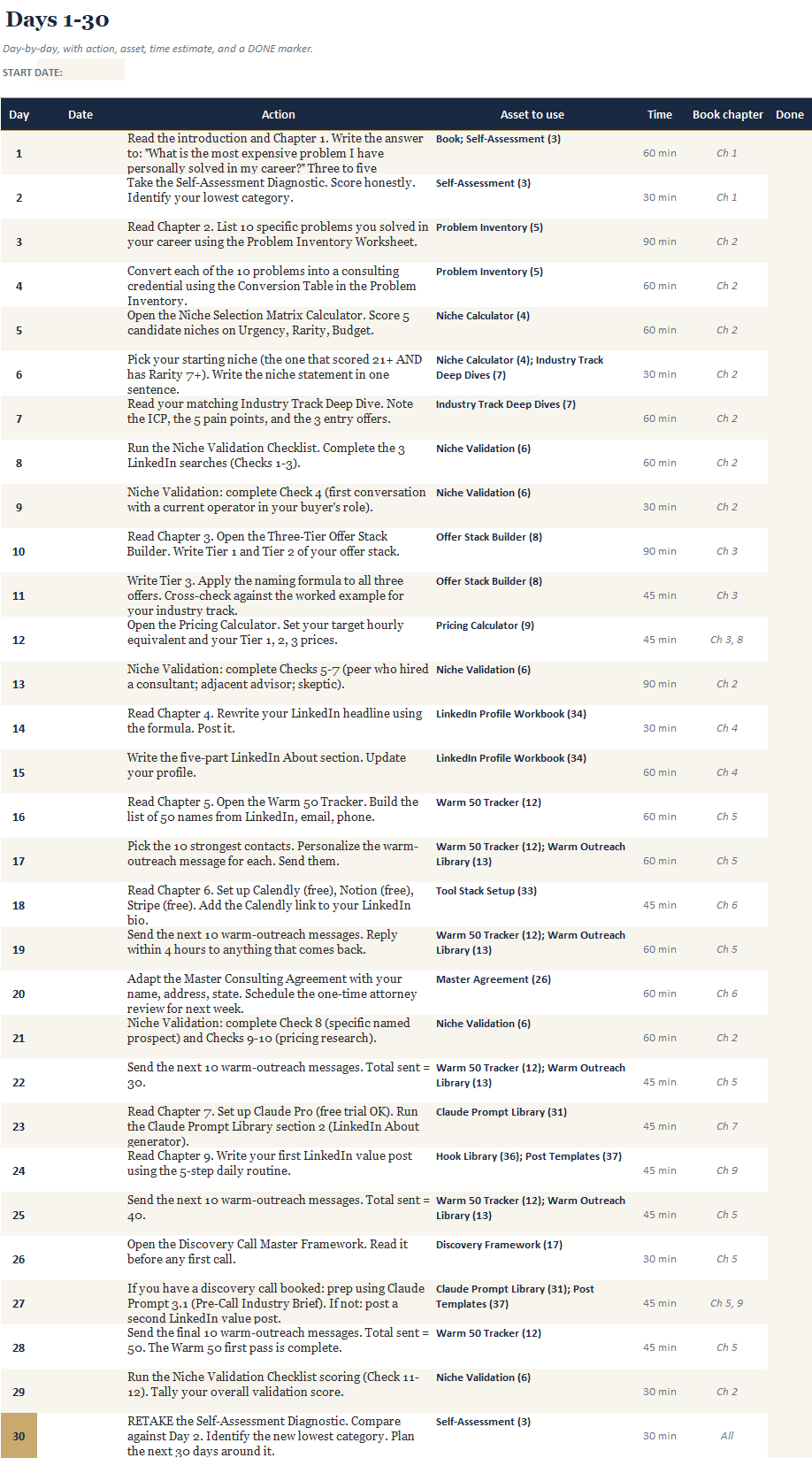
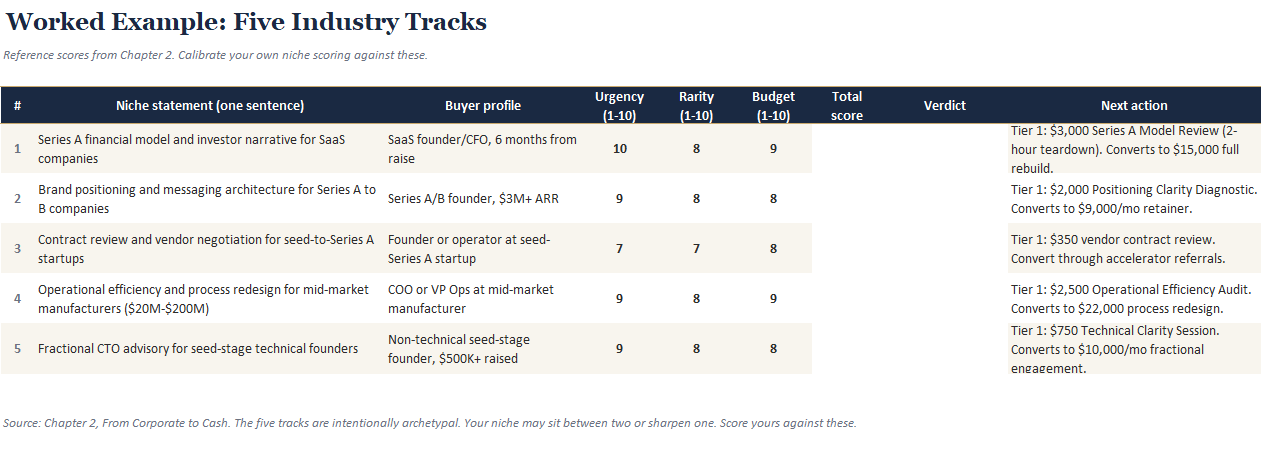
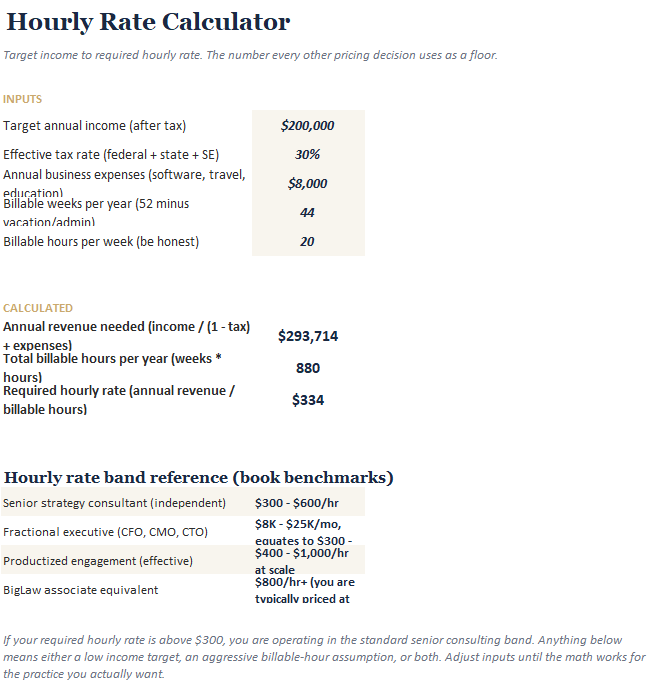
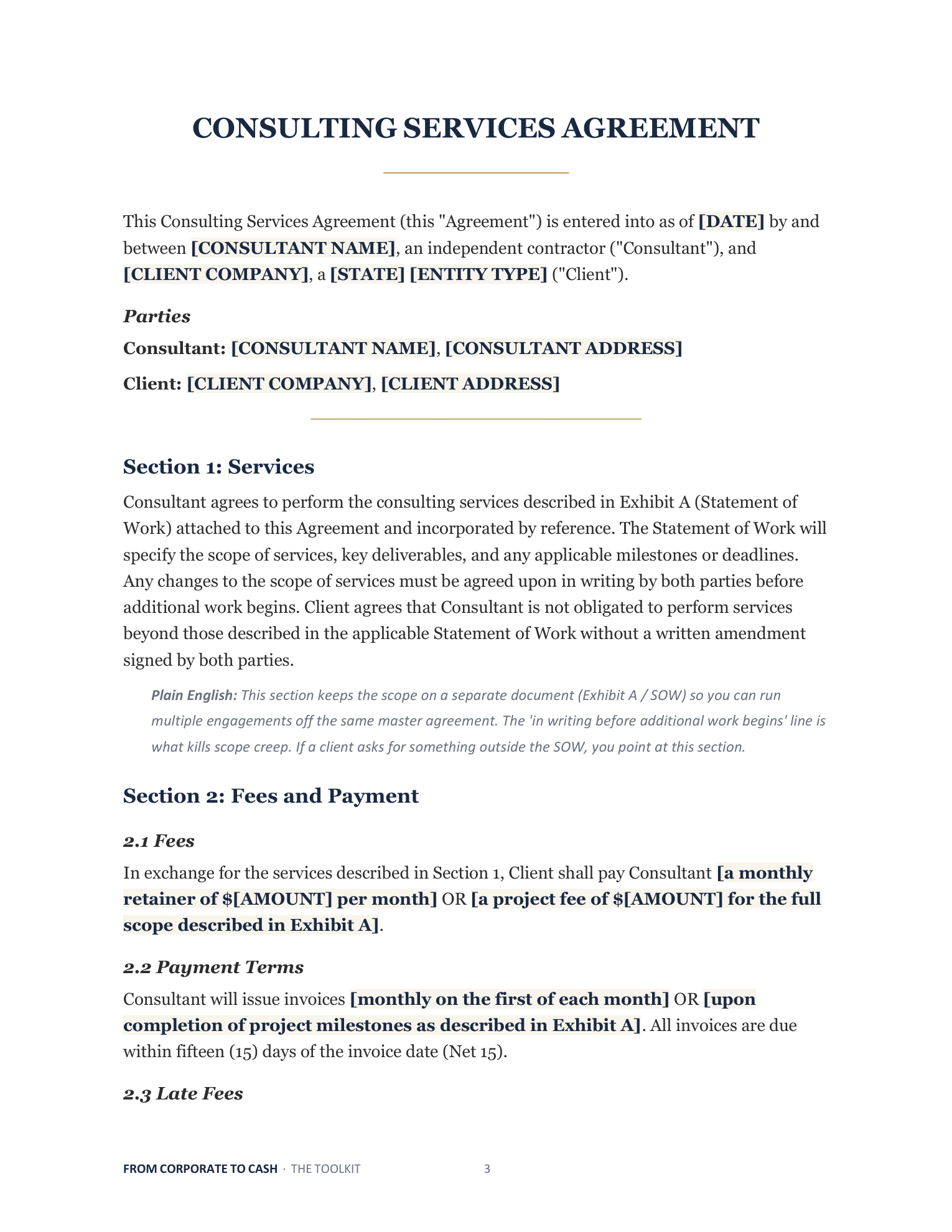
You have seen the pattern: the $20 book that is really a brochure for a coaching program, the free training that ends in a sales call, the guarantee with homework requirements. This is the alternative. Everything the system contains is listed on this page, and everything listed is in the download.
A PivotLab Playbook
How senior corporate experience becomes $10K to $25K consulting clients. In 60 days, not 6 months.
The complete strategy: all 9 chapters, all named frameworks, outreach scripts, pricing guidance, and a sample consulting agreement. Instant PDF.
$49
Buy the BookThe playbook plus all 50 working files: the roadmap, the Niche Selection Matrix calculator, the Warm 50 tracker, the contract pack, and the 41-prompt AI workflow library. Now with the Going Fractional Field Supplement and the Start Here console included. Complete for building the practice.
$99
Get the Bundle09
Common questions
Going fractional means selling your executive expertise to several companies at once on recurring monthly retainers, instead of holding one full-time role. A fractional executive typically serves two to four clients and gives each a day or two per week of senior-level ownership of a function such as finance, marketing, or technology.
Typical published ranges per client are $10,000 to $25,000 per month for a fractional CFO, $8,000 to $20,000 for a fractional CMO, and $15,000 to $35,000 for a fractional CTO. Independent strategy consultants billing hourly typically charge $300 to $750 per hour. These are market ranges, not guarantees; your rate depends on your function, niche, and the cost of the problem you solve.
Most fractional executives run two to four clients at a time. The math is the appeal: two clients in the middle of the CFO band is a $25,000 month, and losing one client cuts income rather than zeroing it, which is more resilient than a single employer.
They overlap but the structure differs. Project consulting is a defined engagement with a start, an end, and a deliverable, then the pipeline restarts. Going fractional means ongoing ownership of a function on a recurring monthly retainer, so revenue is continuous and stackable across clients. Many operators run both: a fractional core plus occasional projects.
For senior operators who already have a network and a track record, roughly 60 days is a realistic window to a first signed engagement when the work is sequenced correctly: niche selection in the first week, offer packaging in the second, then four to six weeks of structured outreach and discovery calls. That sequencing is exactly what the From Corporate to Cash roadmap lays out day by day.
No certification exists or is expected; your track record is the credential. A website can come later: the first clients come from direct outreach to people who already know your work. Entity setup and contracts are operational details worth doing properly, and the toolkit's contract pack covers the documents, though nothing on this page or in the templates is legal advice.
Many operators build the structure before they need it: choosing the niche, packaging the offer, and listing the Warm 50 while still on payroll, then activating outreach on their own schedule. Check your employment agreement for moonlighting and conflict-of-interest clauses before taking on paid work.
Yes. The AI-Powered Practice: Cowork Edition and the 93-prompt library are sold together as The AI Staff Pack for $49 on the store. The Complete Stack includes them alongside everything else on this page, organized in one console. The Going Fractional Field Supplement is included in the $99 Complete Bundle.
No. There is no coaching program, no webinar, and no call to book. The packages on this page and the checkout add-ons are the entire catalog, contents fully listed: the bundle is complete for building the practice, and The Complete Stack adds the AI manuals and conversation scripts, not withheld chapters.
Start by picking the niche, because everything else depends on it. If you want the full machinery, From Corporate to Cash covers the entire path in nine chapters for $49, the $99 bundle adds all 50 working files and the fractional field supplement, and The Complete Stack at $167.98 adds the AI manuals and conversation scripts, organized in one console.
From Corporate to Cash gives you the positioning, pricing, pipeline, and contracts to go fractional in 60 days. The Complete Stack adds the AI operating manual, the prompt library, and the conversation scripts: the whole machine, with the team you no longer have built in.